Analytics
Inflow and infiltration, RDII by site and by catchment, IDF curves and rainfall statistics.
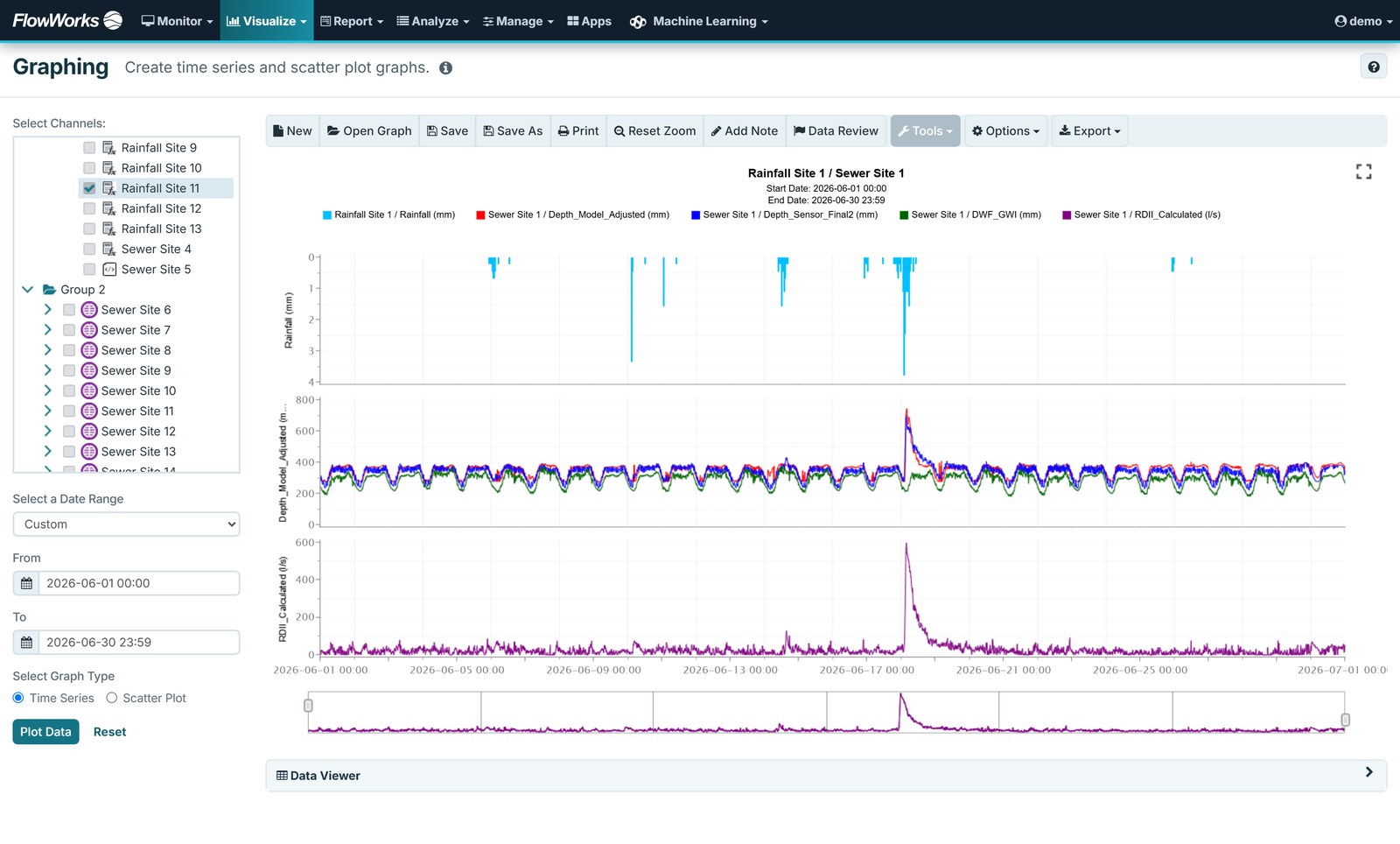
What it does
The analysis most collection system and stormwater work depends on, running against the live source rather than an export.
Auto I&I seeds a project with dry weather patterns and storm event groups already identified, so a study starts from a draft. Average dry weather flow and return-period I&I estimates follow.
Two ways to get rainfall derived infiltration and inflow (RDII) estimates, and they work together. Auto I&I runs continuously and shows where the impact falls, across catchments and individual sites alike. Manual I&I is site-specific and gives an engineer close control when a study has to be defended. Auto can hand a manual project its storms and dry weather patterns, so a new study starts from something rather than from nothing.
On the rainfall side: IDF curve analysis against the local historical record, rainfall mass balance, and duration-based statistics from 5 minutes to 24 hours.
- Auto I&I — continuous RDII estimates, with dry weather patterns and storm event groups identified automatically
- Manual I&I — site-by-site control for a study, seeded from Auto
- Average dry weather flow and return-period I&I estimates (envelope method)
- RDII impact by site and by catchment
- intensity-duration-frequency (IDF) curve analysis against the local historical record, plus rainfall mass balance, statistics and intensity
Where this sits
Analysis
This capability is part of the analysis group.
All features
The other five groups.
Solutions
Or start from the problem instead.
See it on your own data
Feature lists are hard to judge. A demo runs on your sites and your history.