Climate and weather data
Temperature, relative humidity, wind speed and direction, solar radiation, rainfall and snow — from your own stations and from public sources, in one place.
Public data, as easy to connect as your own stations
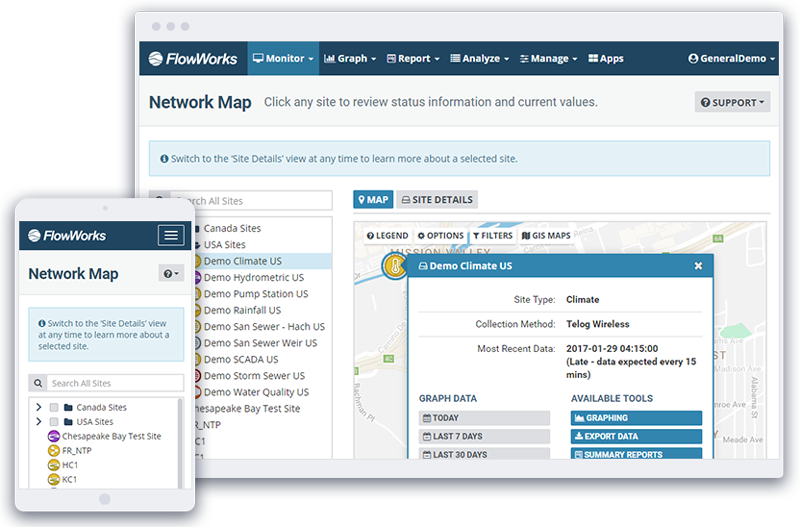
A climate record rarely comes from one place. Some parameters come from stations you own and maintain. Others come from public sources — Environment Canada, NOAA, NASA and similar services — which often cover locations and parameters your own network does not.
In flowworks, external data is just as easy to connect and collect as data from your own devices. Public sources are configured as ordinary sites and channels and pulled in automatically over web API. Your own stations connect as they are, regardless of the manufacturer, through a logger network or SCADA. Once in, every channel behaves the same, whichever side it came from.
- Your own stations, regardless of the manufacturer, through loggers or SCADA
- Environment Canada, NOAA, NASA and similar services as configured sites and channels
- Coverage where you have no station of your own, and a cross-check where you do
- Third-party weather model data as a forecast input
Every parameter, current, in one place
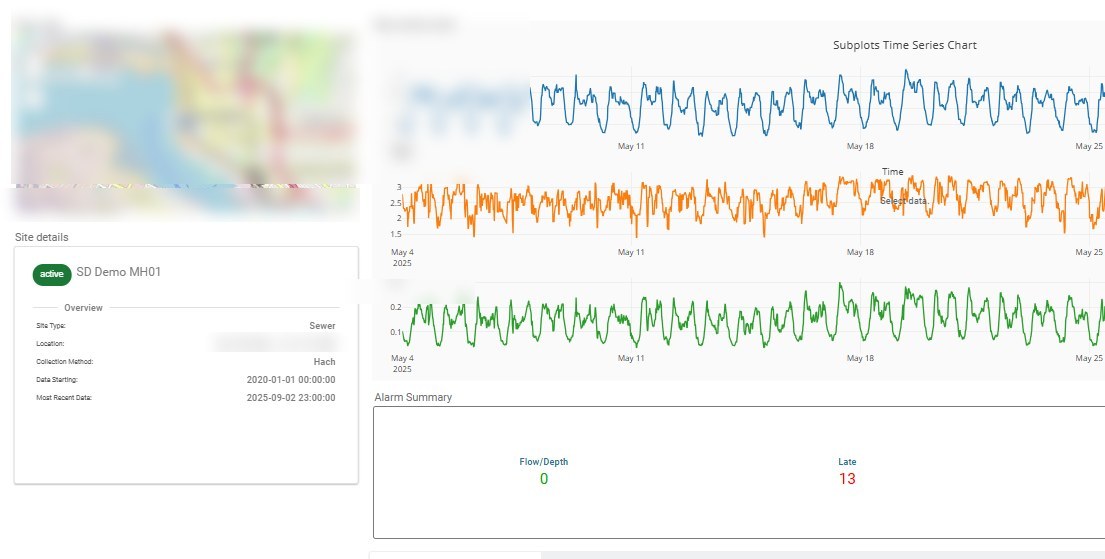
Live and historic climate data become channels, so any parameter can be graphed against any other site in your system on one chart, with a saved template, rather than exported and joined by timestamp. A custom dashboard puts the whole climate network on one screen.
Alarms and notifications can be set on any parameter, by web, email, SMS or voice — for reasons as varied as storm warning and climate research.
- Graphing that combines climate stations with any other site type
- Custom dashboards covering the whole climate network
- Alarms and notifications on any parameter
- Monthly summaries with duration statistics from 5 minutes to 24 hours
- Curve fitting across five general fits to quantify a trend
- Intensity-duration-frequency (IDF) analysis on the rainfall the station records
Raw channels in, real-time summaries out
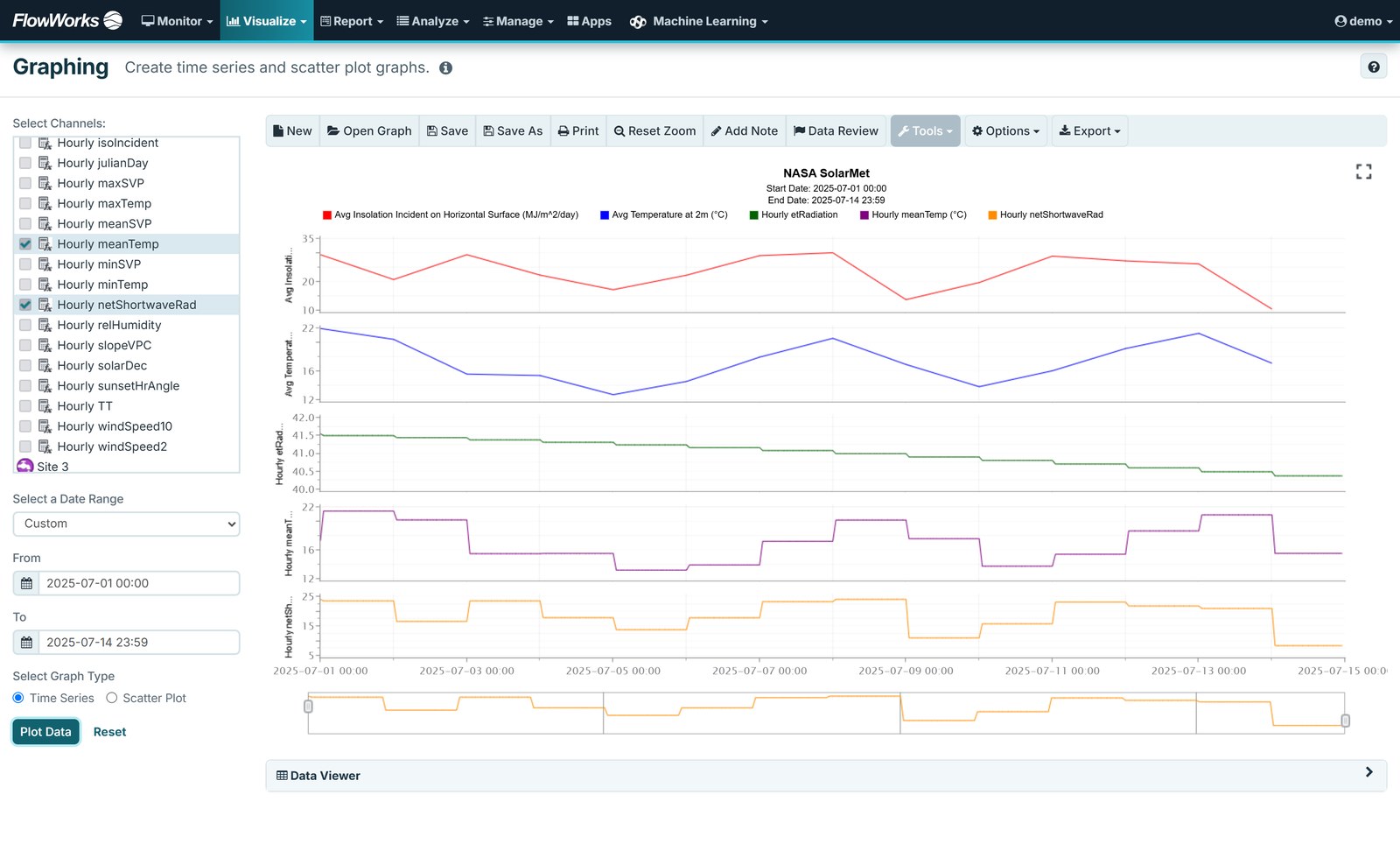
Raw channels are where calculation starts. At a demonstration site on Anderson Creek, daily NASA POWER channels for the location — temperature, insolation, humidity, wind and precipitation — are pulled in automatically over the NASA POWER API. Calculated channels built on them derive hourly values: mean temperature, vapour pressure, extraterrestrial and net shortwave radiation, wind speed at 2 m. Those become new real-time inputs for other calculations, reporting and alarms.
FACE builds those summaries without programming — daily totals and rolling averages, for example. FACE Pro runs your own Python or R where the method is more involved. Potential evapotranspiration (PET) is the clearest example: a FACE Pro script computes it by the FAO-56 Penman–Monteith method from six channels — mean, maximum and minimum temperature, relative humidity, incident solar radiation and wind speed — with elevation, latitude and albedo as site constants. Those channels may come from your own station or from a public source; the calculation does not care which.
Snow melt, soil moisture and evapotranspiration are also the inputs to continuous hydrological simulation — see discharge prediction on streamflow. And the API carries any of these channels out again, to another system or a public website.
- Calculated channels built on raw NASA and other public channels
- Real-time summaries that feed other calculations, reports and alarms
- Potential evapotranspiration by FAO-56 Penman–Monteith, from temperature, humidity, solar radiation and wind
- Snow melt and soil moisture as calculated channels
- Derived channels usable as model inputs, not just as charts
Around the station
Site imagery
A field camera at the station captures snow depth, icing or obstruction as a photo channel stored with the readings, so an odd value can be checked against what the site actually looked like.
Verification records
Date- and time-stamped photos, verification measurements and field observations, kept with the data they qualify rather than in a separate log.
Hardware neutrality
Work with the gauging equipment you already own. flowworks does not sell sensors or telemetry — it supports them, regardless of the manufacturer, which is rather the point.
Related
Rainfall
IDF curves, return periods and radar rainfall.
Streamflow
Level and discharge, monitored and predicted.
Collection & integration
What flowworks connects to, and how new sources get added.
See your own stations and public data on one chart
Most people find the value the first time they put two parameters on one chart that have never been on one chart before.