A 40 million litre target, nine municipalities, and an analysis nobody had time to do
York Region set itself one of the most ambitious inflow and infiltration reduction targets in North America. The constraint was never ambition — it was how long it took to work out, storm by storm and municipality by municipality, where the water was actually getting in.
Owner
The Regional Municipality of York, Ontario — stretching north from Toronto to Lake Simcoe, across nine local municipalities.
Engineering partner
AECOM, who ran the long-term flow monitoring programme and shaped the software alongside the Region's I&I engineers.
Driver
An I&I Reduction Strategy adopted in 2011 with the nine local municipalities, targeting a 40 million litre per day reduction in the York Durham Sewer System by 2031.
Recognition
An AWWA Innovation Award in 2023, and an award at the International Water Association conference in 2024 — two international awards in two years for the Region's I&I Reduction team.
The problem
Inflow and infiltration is stormwater and groundwater getting into a sanitary system that was never meant to carry it. It consumes capacity reserved for future growth, it raises treatment cost, and at the extreme it is what puts sewage where nobody wants it. Reducing it means knowing where it is entering, and by how much — which means analysing flow and rainfall data storm event by storm event.
York Region had the data. Its long-term flow monitoring programme is one of the largest and most advanced flow and rainfall monitoring programmes in North America. What it did not have was a way to turn that volume of data into defensible rainfall derived infiltration and inflow (RDII) numbers at the rate the storms arrived.
Done by hand, an analysis cycle means building dry weather patterns for each site, finding the storm events that meet the rainfall criteria, deriving RDII volumes, and then assembling the result into something an engineer can put in front of nine municipal councils. It is slow, it is expensive in senior engineering time, and because it is slow the answer tends to arrive well after the decision that needed it.
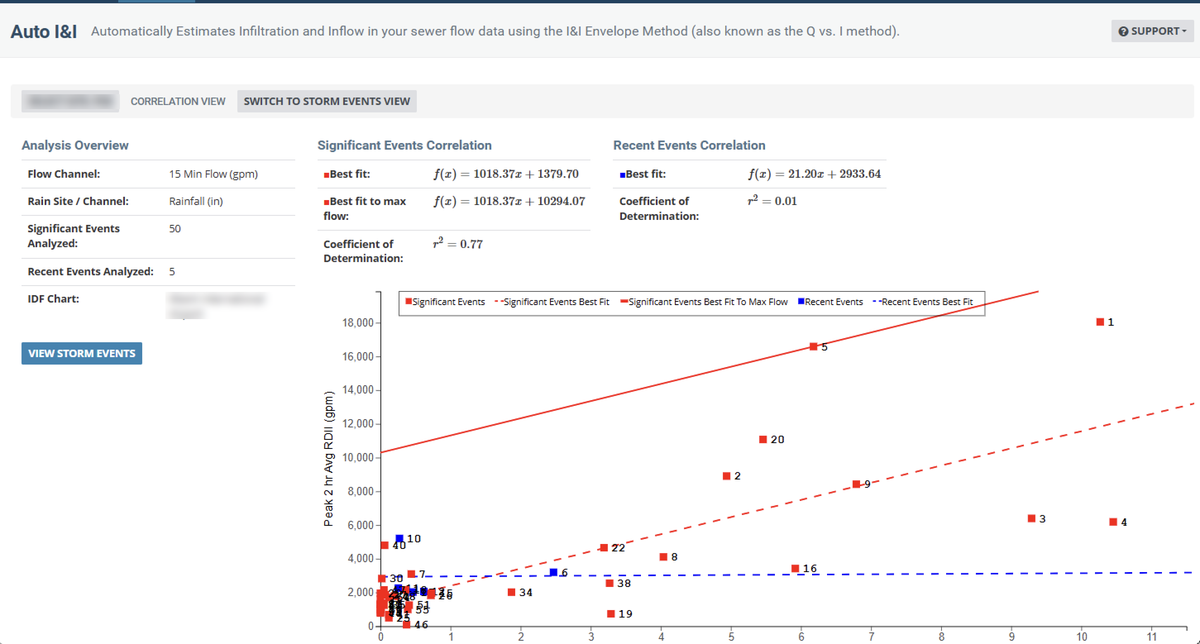
The analysis runs itself, and keeps running
Auto I&I was beta-tested inside York Region's programme with AECOM, and built with input from the Region's own I&I engineers. The Region bought it once the beta proved out.
Rather than an engineer constructing each dry weather pattern, the machine learning creates and continually refines them as data arrives. Rather than hunting for qualifying storms, the event finder detects them against the rainfall criteria. RDII volumes are derived per event and per catchment, and the result is drawn on a map with catchments colour-coded by whichever metric matters — volume per acre, volume per pipe length, whatever the Region needs to compare.
- Dry weather patterns generated and refreshed automatically
- Qualifying storm events found rather than looked for
- Every catchment on one map, ranked by the metric that matters
- Storm events comparable against each other, not just described
Across all nine municipalities
90%+
Confidence in the Region's inflow and infiltration analysis.
78%
Reduction in the time an analysis takes.
~$40,000
Labour cost saved per analysis cycle.
Why it mattered beyond the software
The point of cutting an analysis from weeks to days is not the days. It is that an analysis you can afford to run often becomes an analysis you actually use. A programme aiming at 2031 needs to know each year whether it is on track, where the next dollar of rehabilitation should go, and whether last year's work did what it was supposed to.
York Region has been ahead of that curve. Having adopted the strategy in 2011, by 2020 it had passed its interim target two years early, with a total reduction of 22.87 million litres per day.
The work has been recognised twice internationally. The Region's I&I Reduction team won an AWWA Innovation Award in 2023 for the machine learning project, and in 2024 its “Comprehensive Approach to Tackling I&I in Wastewater Systems” was recognised at the International Water Association conference — a second international award in two years.
On what this is: Auto I&I is a supplemental application to infinitii flowworks rather than part of every subscription. It works on the data you are already collecting. Ask us what it would look like on your own network.
More customer stories
CSL Services
An engineering firm that keeps the I&I analysis tool, in their VP’s words, “in my hip pocket”.
See it on your own system
A walkthrough on your own flow and rainfall data shows what the analysis looks like before you commit to anything.