CSL Services cut engineering time on I&I studies by 25%
— and by up to 50% on larger projects — by replacing spreadsheet-based inflow and infiltration analysis with the flowworks I&I tools.
Company
CSL Services Inc.
Contact
Bill Dawson, Vice President
Location
New Jersey, USA
Scale
50 employees; over two million meter-days logged
The problem
Inflow and infiltration quantification begins with accurate, reliable and repeatable sewer flow data. I&I sources move both spatially and temporally with soils, pipe condition and materials, construction practice, storm drainage, cross-connections, system age and climate — so the analysis has to be redone, carefully, for every study.
Uncontrolled I&I is not a modelling curiosity. Excessive wet weather flow carries the health risk of sanitary overflows, raises operation and maintenance costs, and consumes capacity the system was holding for future growth.
CSL is an engineering field services company specialising in wastewater collection system flow monitoring and condition assessment, and one of the leading flow monitoring and pipeline inspection firms in the United States. Before flowworks, its engineers loaded I&I data by hand into Excel templates they had built themselves.
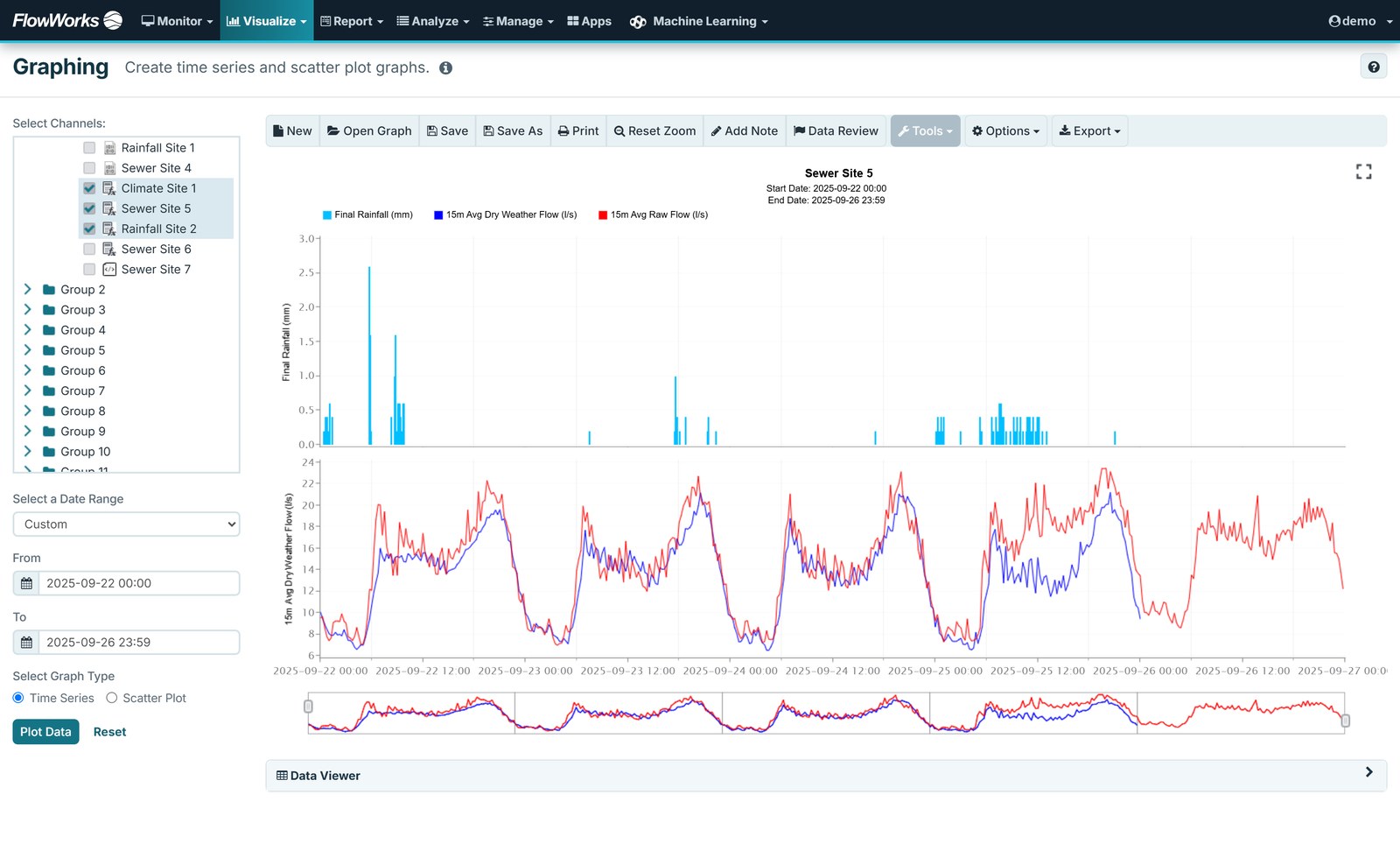
Automated dry weather patterns and storm event groups
The flowworks I&I tools generate dry weather patterns automatically and find storm event groups automatically, which removes the two slowest manual steps in a study. A rainfall derived infiltration and inflow (RDII) chart gives a quantitative view of the collection system’s wet weather response, and a correlation report fits a linear regression between rainfall and RDII to support forecasting.
Both the graphs and the underlying data export, so the analysis goes into a client report without being rebuilt.
- Automated dry weather pattern generation
- Automated storm event group finding
- RDII charts quantifying wet weather response
- Correlation reporting between rainfall and RDII
- Graph and underlying data export straight into reports
The result
Bill Dawson runs temporary flow studies that typically last from 60 days to six months and can involve 50 or more flow meters. Engineering time on those studies fell by an average of 25%, and by up to 50% on larger projects involving 20 or more meters.
The saving is measured in engineering labour, but Dawson is clear that the larger benefit is being able to scale over and analyse large datasets at all.
It also changed CSL’s commercial position. Much of its work comes from engineering firms who do not perform this analysis daily and hand the responsibility over — the pattern described on our page for engineering firms.
“This is a competitive differentiator for us. In many cases we work for engineering firms. Since they don’t do this kind of analysis every day, they hand that responsibility to us. We do this all day long with FlowWorks … anybody we’ve ever done flow monitoring studies for with FlowWorks comes back to us again.”
More customer stories
City of Richmond, CA
Collections and treatment plant data on one platform, with meters from three vendors.
City of Kimberley, BC
Monitoring and alarming at a fraction of the cost of the SCADA system they had priced.
See it on your own system
A demo runs on your sites and your history. Bring the problem you have not been able to solve easily.